A humanoid pipettes in a lab. What does the video prove?
A claim of 69% success across three tasks, and a twenty-second clip showing one of them, once.
One continuous take, one task, one success. The three numbers below are the reason this is a study and not a repost.
What the clip shows
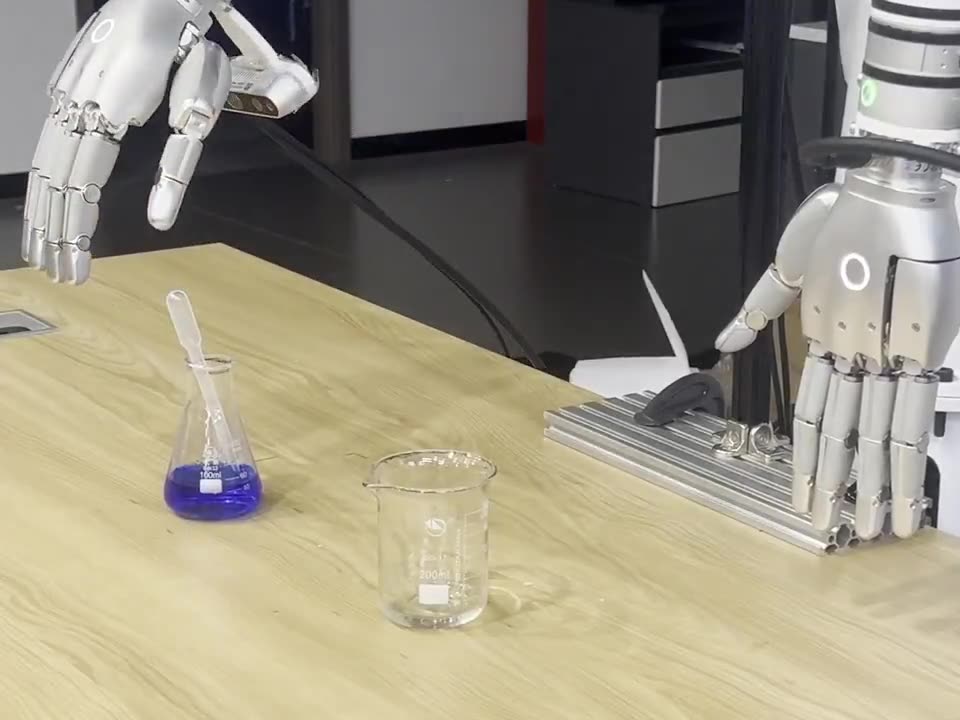
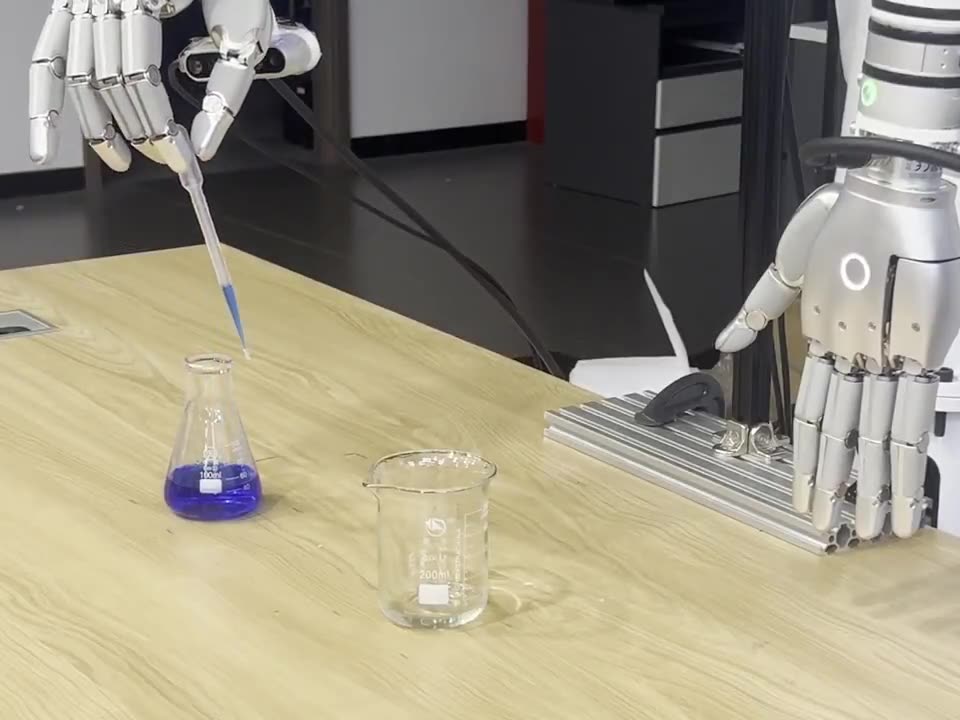
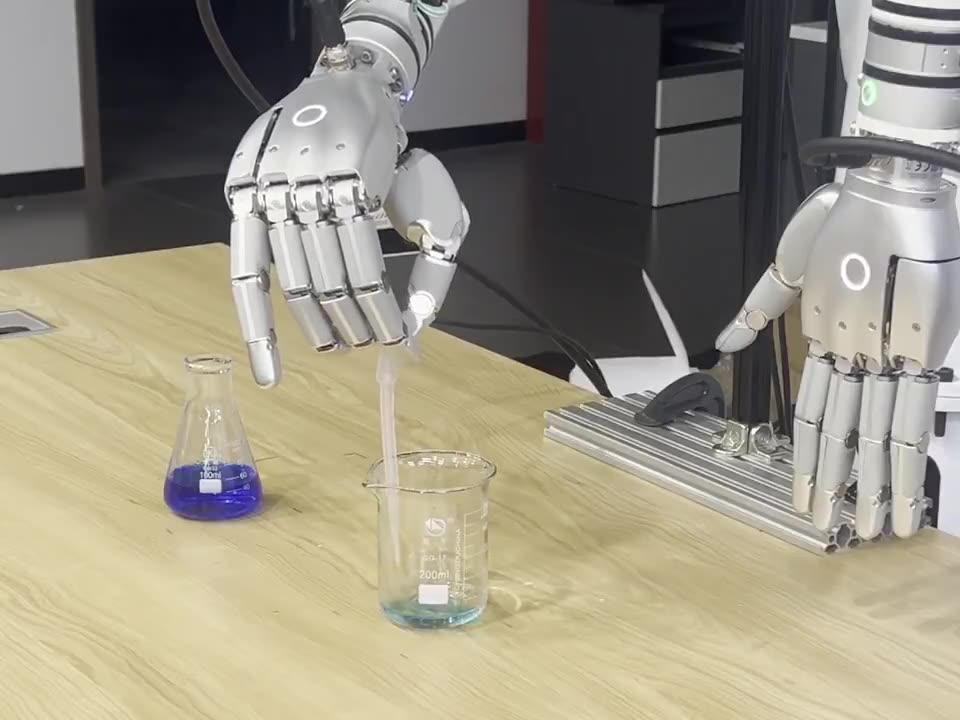
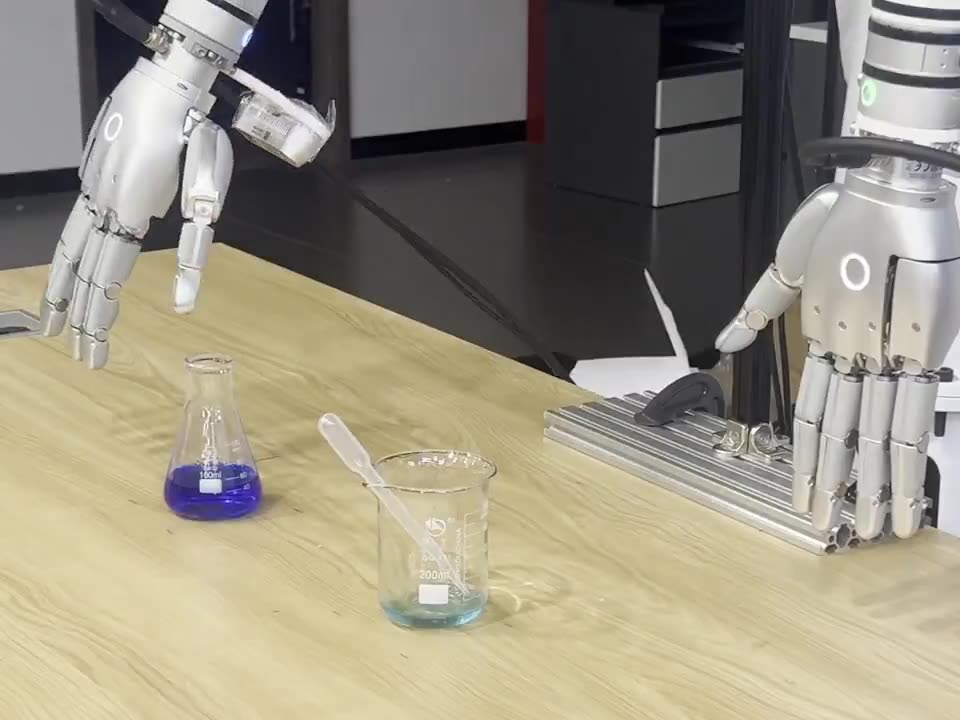
A fixed camera on a lab bench. Two anthropomorphic five-finger hands hang into frame; only one of them moves for the entire twenty seconds, so the task as filmed is unimanual. No arm, torso or head is ever visible, so the platform cannot be identified from this footage.
What the clip does not contain
-
No tactile signal
No sensor overlay, no force trace, no contact highlighting — nothing that shows the fingertip feedback the method is named for.
-
No baseline
No side-by-side against a policy without touch. A successful run says nothing about what the tactile channel contributed.
-
No failure or recovery
The claimed mechanism is correcting during contact. Nothing in the clip is perturbed, slipped or recovered.
-
No trial count
One take. A 69% average implies a denominator that is nowhere shown.
-
Unknown playback speed
The post itself states that official project videos run at 5x. Whether this is one of them is unstated, so dexterity cannot be read off it.
-
No primary source
The post cites “an August 26 arXiv preprint” and links none. Two searches — by name and by the task triple — returned nothing matching.
None of this makes the claim false. It makes it unverified — a different and more useful word. A clean single take is a demonstration; 69% is a measurement, and the clip is not one.
Why we cannot reproduce the method as stated
- 1 Blocks the method
We have no tactile channel
The claim is specifically about fingertip feedback closing the loop during contact. Our G1 + Inspire model exposes no per-fingertip tactile signal. A policy conditioned on a sensor we do not simulate can be imitated, not evaluated.
- 2 Blocks the task as filmed
MuJoCo has no liquid
Aspirate and dispense have no counterpart in our simulator. What survives is the manipulation skeleton — grasp a thin cylinder, lift it clear, transport it, hold orientation, release on target. That part is measurable, and we will not quietly score the easier thing as if it were the harder one.
- 3 Dissolved
No GPU on this host — resolved
This block is gone. The host is still a Xeon 8581C with no CUDA device, but rented compute was verified by running nvidia-smi inside the containers rather than trusting a price list: six Modal accounts each give an A100-SXM4-80GB, and Beam gives an RTX 4090. π₀ inference now runs on an A10. What this block correctly predicted is that the work would move off this machine, and it has.
Publishing the blocks before the result is the point. A study that only appears once it has a favourable number is advertising.
What has run
The experiment this page originally opened — a no-touch floor rebuilt on our own G1 + Inspire model — was overtaken. A published benchmark with a pipetting task in MuJoCo already exists (AutoBio, ICLR 2026), so the honest move was to run that rather than build a private lookalike and score it ourselves. Everything below is measured on the authors' unmodified scene.
- Scene
- AutoBio pipette, unmodified
- Embodiment
- Dual UR5e + DexHand / 2F-85
- Simulator
- MuJoCo 3.3.0
- Harness baseline
- 100 / 100 episodes
- Policy
- π0 base, untuned
- Status
- Inference verified
The 100/100 is not a grasp result and is not offered as one. It is the scripted harness completing its own positioning routine a hundred times without drift — the check that the measuring instrument is stable before anything is measured with it. Re-running it on the same seeds reproduces bit-for-bit.
Thirty seconds of π0
The full loop closes: scene → observation → π0 → action → MuJoCo → next observation, thirty cycles, thirty seconds of simulated time. All fourteen driven joints move, including both absolute-encoded actuators — the pipette plunger and the gripper. No NaN, no instability, peak joint velocity 1.02 rad/s.
And the robot does not do the task. The one free body on the bench moved 0.912 mm in thirty seconds. The pipette tip never came closer than 74.8 cm to the tube; it moved away for the first twelve cycles. There were zero contacts between the robot and any manipulable object. This is the expected outcome — the checkpoint is π0 base, which has never seen this task — and it is reported because the loop working and the task working are different claims.
Our own classifier got it wrong first. It reported
OBJECT_INTERACTION, because it counted a contact by body name and the tube
resting in its own rack matched — a contact already present before the policy ran.
Removing that, a second test then fired on start-versus-end distance alone, blind to a
trajectory that went the wrong way and happened to come back. Both defects flattered the
result. The corrected verdict is sustained motion, nothing more.
A render can look like progress. In the final frame the pipette appears poised over the rack. Measured, the tip is 74 cm above it and 37 cm across. The camera collapses depth and height. That frame is on the render page, next to the numbers that contradict it.
The benchmark does not install
Three of AutoBio's own pinned dependencies have since broken, and none of them fails
loudly. NumPy's eigenvalue routine changed dtype, so the liquid-surface check crashes on a
perfectly circular meniscus. The pyav distribution was deleted from PyPI, which
blocks the data loader. And torchvision.io.VideoReader was removed upstream.
Each is a one-line fix once found; together they are the reason a published recipe from this
year no longer runs. This is a reproducibility finding in its own right, and it is not a
criticism of the authors — it is what happens to any pinned recipe left alone.
The honest part
We still have no number on the claim. Nothing here measures what tactile feedback contributes, because block one has not moved: we have no fingertip channel to ablate. What we have is a working instrument and an untuned policy running inside it. The 69% remains unaddressed, and we are not going to dress adjacent results up as an answer to it.
The footage is not ours. It is quoted, with credit, because the claim it carries is the subject. Our own images will replace it the moment we have any.
We may be wrong about the blocks. If the preprint turns up and names a sensor we can model, block one dissolves and the experiment changes. Send it to us.
Everything is in the open
The frame-by-frame reading, the provenance of the clip, the failed searches for the primary source, and the machine measurements — all in the repository, from the first day rather than the last.
Forenly-AI-Lab/reproduction-002The Skill Layer for humanoid robots
Forenly AI turns real scenes into simulation where humanoids learn their skills — then transfers them onto the machine.