A humanoid that wipes a counter with a cloth
A Unitree G1 learns an autonomous kitchen-wipe skill inside a simulation twin of a real kitchen. The pink cloth is a deformable body, the counter is contact-rich, and the policy trains end-to-end from teleoperation demonstrations.
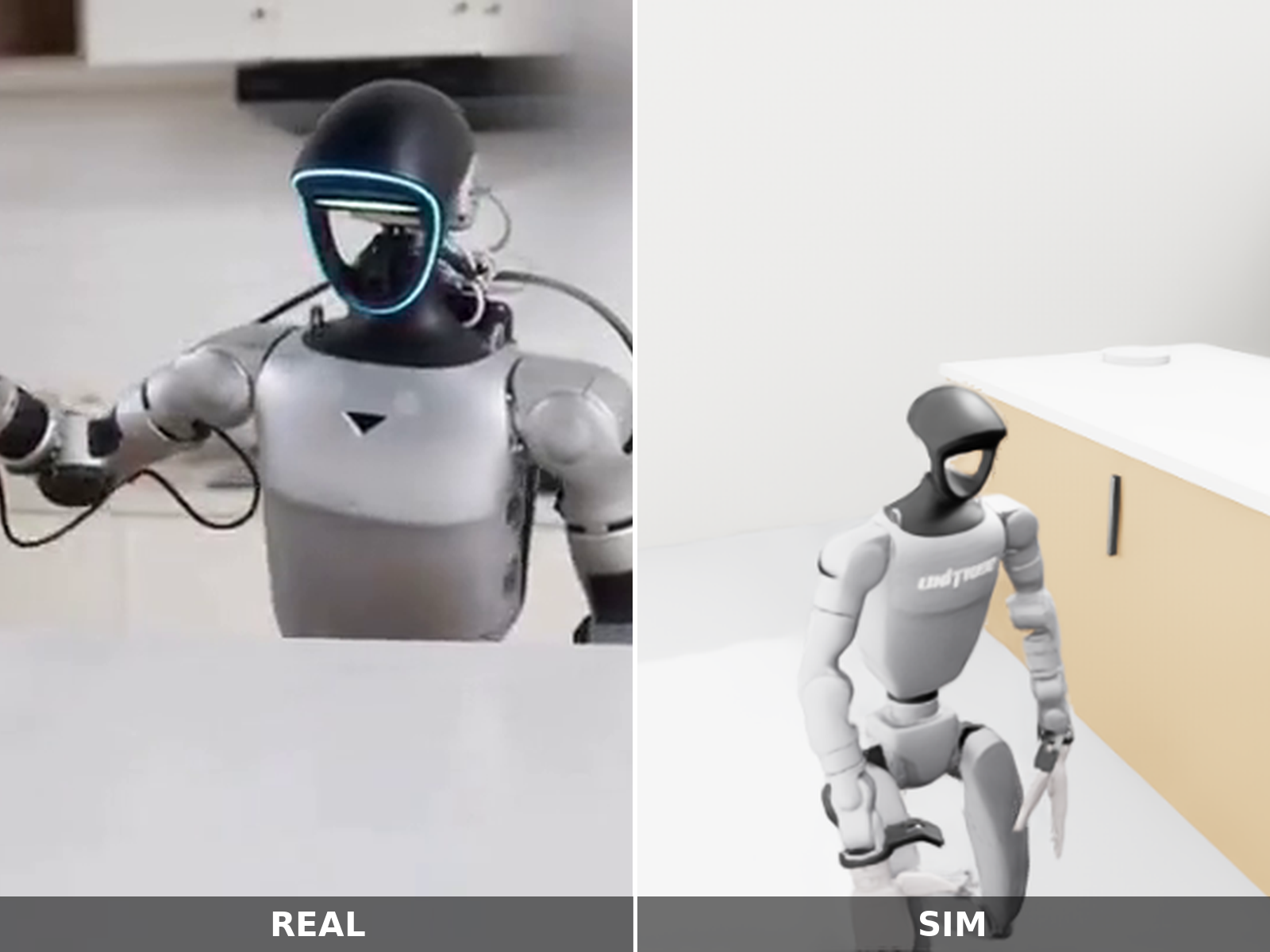
Left: frame from real teleoperation video. Right: the simulation twin where the policy trains. Same kitchen, same task.
What you're looking at
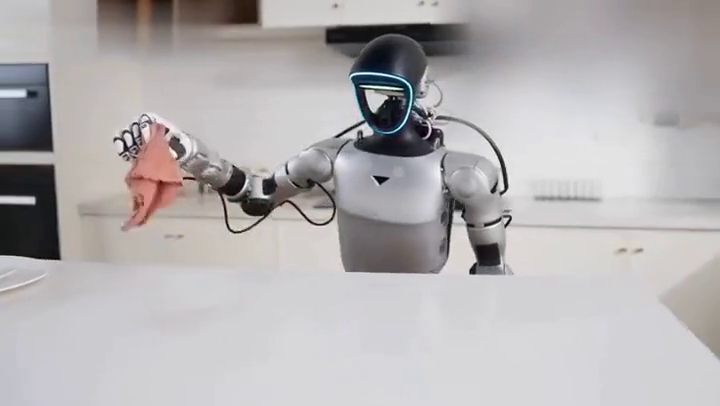
A kitchen-wipe task for the Unitree G1: pick up a pink cloth from the counter, wipe across the surface, and put it down. The task is trained from 22 real teleoperation demonstrations collected on the physical robot using the Inspire hand.
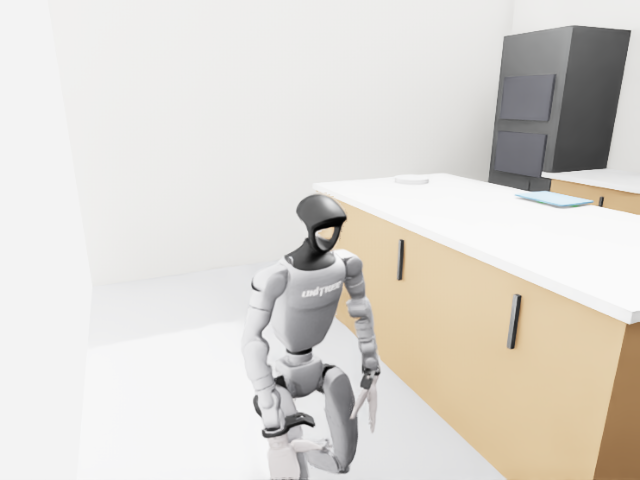
The simulation twin faithfully reproduces the kitchen geometry, counter height, and cloth physics. The cloth is simulated as a VBD (Variational Block Descent) deformable — not a rigid proxy — so the crumpling, draping and friction behaviour match what the real cloth does.
The end-to-end pipeline chains multiple stages: FOI Sim for physics and rendering, FOI Verse for visual quality assurance, a vision-language model for task-level reasoning, and an action head that outputs joint commands.
Why it matters for Forenly
Study 02 showed a humanoid walking inside a reconstructed scene — locomotion in a splat world. This study is the next stage: contact-rich manipulation — a humanoid interacting with deformable objects on real kitchen surfaces.
A wipe is deceptively hard. The cloth deforms, the counter has edges, the robot's wrist must track a sweeping path while maintaining downward pressure. Solving it in simulation with faithful cloth physics is the precondition for transferring the skill to the real G1 — where the same contacts, the same friction, and the same cloth crumpling apply.
The honest part
The policy is trained from demonstrations, not from reward engineering. That means it reproduces the wipe motion the teleoperator showed, but does not yet generalize to different counter shapes, cloth sizes, or starting positions. Generalization requires either more demonstrations or a sim-trained RL policy — both are in progress.
Sim-to-real transfer for the wipe skill has not yet been validated on hardware. The sim twin is geometrically faithful, but the cloth-surface friction gap between VBD simulation and real cotton-on-marble is not yet measured. The acceptance criterion is successful transfer, not render similarity.
The Skill Layer for humanoid robots
Forenly AI turns real scenes into simulation where humanoids learn their skills — then transfers them onto the machine.